When you’re planning a development, build costs and land prices are usually top of mind. But there’s another major statutory cost that can instantly make or break your margins: local authority infrastructure payments.
In UK land development, these costs generally come through two legal routes: Section 106 (S106) Agreements and the Community Infrastructure Levy (CIL).
While both exist to help local communities absorb the impact of new developments, they work under completely different legal rules. Knowing how each framework operates and where you actually have room to negotiate is crucial to keeping your project viable and protecting your bottom line.
What is a Section 106 Agreement?
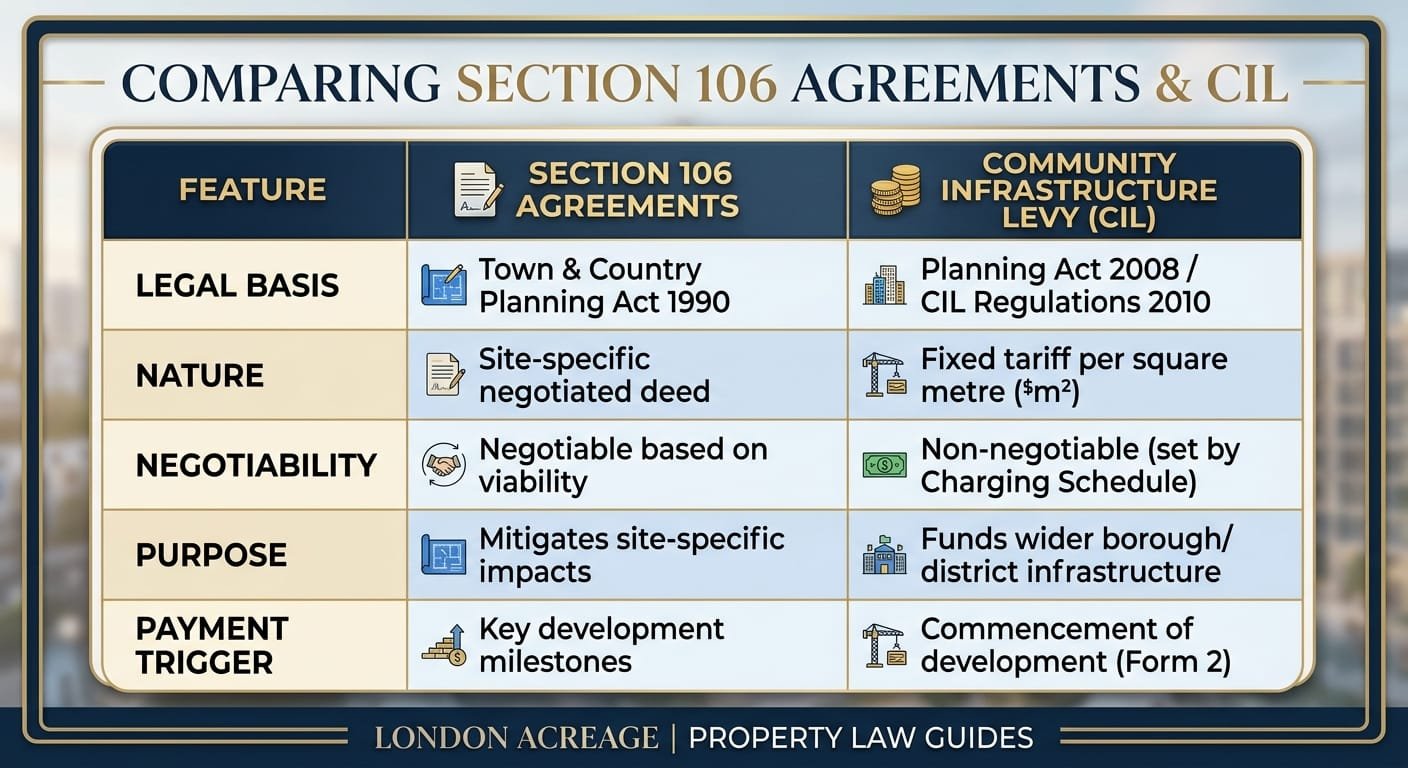
A Section 106 agreement (named after Section 106 of the Town and Country Planning Act 1990) is a legally binding contract between a developer and the Local Planning Authority (LPA). Think of it as a tailored, site-specific agreement designed to resolve planning issues that would otherwise lead to a council refusing your application.
By law (specifically Regulation 122 of the CIL Regulations 2010), any obligation in an S106 agreement must pass three strict legal tests:
Necessary: It must be essential to make the development acceptable in planning terms.
Directly Related: It must directly link to the proposed site and its immediate impact.
Fair and Reasonable: It must be proportionate in scale and kind to the scheme you're building.
Common S106 requirements include providing a percentage of affordable housing, paying for local road or junction improvements, or contributing to local schools and green spaces. Crucially, S106 obligations "run with the land" meaning they stay tied to the property and bind whoever owns it next until the terms are officially fulfilled or modified.
How the Community Infrastructure Levy (CIL) Works
While Section 106 is a site-by-site negotiation, the Community Infrastructure Levy (CIL) is a fixed, non-negotiable charge. Created under the Planning Act 2008, CIL gives local councils a standard way to raise funds for broader borough-wide infrastructure projects like transport hubs or parks.
CIL is calculated per square metre of net additional Gross Internal Area (GIA) created. Councils set their own rates in a published document called a Charging Schedule, which often varies depending on where your site sits and what you’re building (for instance, residential builds versus commercial units).
A few key CIL rules every developer should know:
Automatic Application: If a local authority has adopted a CIL Charging Schedule, it applies automatically to qualifying builds that add 100 sq m or more of new space, or build a new dwelling.
Annual Indexation: CIL rates are indexed annually against the RICS CIL Index, meaning the cost per square metre automatically goes up over time.
Statutory Exemptions: You can claim relief for self-build homes, social housing, or charitable projects but only if you submit the formal paperwork and get it approved before any work starts on site.
Negotiating S106 to Protect Your Project Margins
Because CIL is fixed by local policy, your main opportunity for legal negotiation lies within your Section 106 agreement. Unrealistic council demands especially around high affordable housing quotas can quickly erode a developer’s return.
Here are three key ways developers can legally protect their margins:
1. Leverage Financial Viability Assessments (FVAs)
If S106 requirements make your scheme unviable, you can submit a formal Financial Viability Assessment with your planning application. An FVA uses detailed financial modeling to prove whether the combined weight of CIL, S106 demands, build costs, and land value still leaves room for a realistic developer profit margin (typically 15%–20% on Gross Development Value). If the numbers show the project will fail, councils can agree to reduce affordable housing requirements or defer financial contributions.
2. Apply for Section 106A Modifications
Under Section 106A of the 1990 Act, you can formally apply to modify or discharge an existing agreement if it no longer serves a valid planning purpose or if market conditions have shifted dramatically. While standard applications usually happen five years after an agreement is signed, developers can initiate informal renegotiations with the council much earlier if viability drops.
3. Negotiate Smart Payment Phasing
Cash flow matters just as much as overall cost. Rather than agreeing to pay S106 contributions upfront upon site implementation, negotiate clauses that tie payments to key revenue milestones such as reaching 50% or 75% site occupation.
Summary
Understanding the distinction between Section 106 agreements and CIL is vital for effective site sourcing and financial planning. While CIL requires strict procedural compliance from day one to avoid heavy penalties, Section 106 leaves room for strategic negotiation backed by sound financial evidence. Getting both right during your initial due diligence ensures you protect your cash flow and keep your project profitable.
Future articles will explore key title deed legalities and rights of way during initial site identification, how to navigate rights of light in urban developments, and the legal process for identifying and discharging restrictive land covenants
Key Differences of Section 106 vs. CIL: